
Rice up 20%, rates at 5%: the squeeze on Philippine households
Philippine inflation hit 7.2% in September 2026, rice prices rose 20.3% and the BSP rate is 5%. What the numbers mean for a household budget.
Published

As of October 2026, Filipino families are paying more for almost everything they buy. Borrowing money costs more too. Prices were 7.2% higher in September than a year before. That is the fastest rise since March 2023. Rice, the food most families eat every day, cost a fifth more than a year earlier. The central bank has raised interest rates three times since April, and it meets again on 22 October.
Prices in the Philippines rose 7.2% in the year to September 2026, up from 6.1% in August, according to the Philippine Statistics Authority (PSA). Food, utilities and transport caused most of the rise. Rice cost 20.3% more than a year earlier. The Bangko Sentral ng Pilipinas (BSP), the country's central bank, has raised its main interest rate to 5.00% to stop prices from rising this fast for too long. Metro Manila's minimum wage went up by ₱60 a day in September. Inflation is well above the BSP's goal of 2-4% a year. It is also rising fastest for things families can't easily cut back on: rice, transport and utilities.
7.2%
Headline inflation, Sept 2026 (PSA)
20.3%
Rice inflation, Sept 2026 (PSA)
5.00%
BSP policy rate since 27 Aug 2026
The headline figure
Inflation is how fast prices go up. The main measure, called headline inflation, tracks the prices of everything a typical household buys. The PSA compares each month with the same month a year before. This is called "year on year".
In its September report, released on 6 October 2026, the PSA put headline inflation at 7.2%. In August it was 6.1%. In September 2025 it was only 1.7%. The rate had been slowing for four months in a row. Now it is rising again.
There is also core inflation. It leaves out some food and fuel items whose prices jump around a lot. Core inflation rose to 4.7% from 4.1%. This means prices are not just rising for a few items. The pressure is spreading.
September's 7.2% matched April's 7.2%, the highest rate so far this year. Prices started to climb in March. The BSP said the conflict in the Middle East pushed up the cost of fuel and food. In its April policy statement, the BSP reported inflation of 2.4% in February and 4.1% in March.
Headline inflation, year on year
Philippines, monthly, 2026, %
PSA figures as first published. February, March, May and July are taken from BSP Monetary Board highlights, and April and June from BusinessWorld reports of the PSA releases. Source: Philippine Statistics Authority
The national number hides big differences between places. In Metro Manila, inflation was 5.4%. In the rest of the country, it was 7.6%. The Bangsamoro Autonomous Region in Muslim Mindanao had the highest rate, at 9.7%. MIMAROPA had the lowest, at 5.9%. So on average, families in the provinces are seeing prices rise faster than families in the capital. The gap has been there since at least May.
Metro Manila vs the rest of the country
Inflation, year on year, 2026, %
PSA figures as first published. May to August are from Daily Tribune reports of the PSA releases. The PSA's July release later put June outside Metro Manila at 6.8%. Source: Philippine Statistics Authority, as reported by SunStar
Where the increase came from
The PSA shows how much each type of spending added to the 7.2%. These shares are counted in percentage points, which simply means parts of the total rate. Food and non-alcoholic drinks added 2.6 points. Housing, water, electricity, gas and other fuels added 1.7 points. Transport added 1.3 points. Together, these three groups make up most of the total.
Prices inside those groups rose fast. Transport cost 14.6% more than a year earlier. Housing and utilities cost 8.4% more. Food on its own, without drinks, cost 6.8% more, up from 4.6% in August. Vegetables, root crops and beans swung the most. In August they were 3.4% cheaper than a year before. In September they were 10.7% dearer.
What rose fastest in September
Price rise vs September 2025, selected items, %
Utilities is the PSA group for housing, water, electricity, gas and other fuels. Vegetables includes tubers, plantains, cooking bananas and pulses. Fruit includes nuts. Fish includes other seafood. Source: Philippine Statistics Authority, as reported by GMA News
Rice stands out. The PSA's rice index was 20.3% higher in September than a year before. In August the rise was 19.4%. It has been going up for months. BusinessWorld reported rice inflation of 15.6% in May and 15.0% in June. Cereals, the group that includes rice, made up 4.4 of food inflation's 6.8 points in September.
Rice prices, year on year
Philippines, PSA rice index, monthly, 2026, %
PSA figures as first published. April and May from GMA News (5 June 2026), June from Daily Tribune (7 July 2026), July and August from Daily Tribune (4 September 2026), September from GMA News (6 October 2026). Source: Philippine Statistics Authority, as reported by GMA News and Daily Tribune
It is fair to add some context. Prices a year ago were unusually calm. In September 2025, headline inflation was 1.7% and food inflation just 0.8%. So part of today's high rate comes from how cheap food was last year, not only from how dear it is now. That doesn't make rice any cheaper at the market.
Why the central bank is raising rates
The BSP's main tool is its policy rate. This is the interest rate it uses to steer what banks charge each other, and in turn what they charge you for loans. The BSP's official name for it is the target reverse repurchase rate. When the BSP raises it, borrowing gets more expensive. People and businesses then tend to borrow and spend less, which can slow price rises.
The BSP started raising the rate in April. It added 0.25 percentage points at each of its April, June and August meetings. (Banks call 0.25 percentage points "25 basis points".) That took the rate from 4.25% to 5.00%. In its 27 August statement, the Monetary Board, which sets the rate, said core inflation was expected to "remain elevated". It also warned that price rises "could broaden further due to El Niño conditions and potential wage adjustments". One of the risks it named was higher local rice prices because of El Niño.
BSP target reverse repurchase rate
After each 2026 rate decision, %
The pre-April level is implied by the 23 April decision, a 25 basis point rise to 4.5%. Source: Bangko Sentral ng Pilipinas, Monetary Board highlights
Most economists expect a fourth rise at the meeting on 22 October. In a BusinessWorld poll published on 18 October, 20 of 22 economists expected a rise of 0.25 percentage points, to 5.25%. Two expected a bigger rise of 0.5 points. Analysts also point to the peso. It closed at a record low of ₱63.09 to the US dollar on 19 and 20 October, based on Bankers Association of the Philippines data reported by BusinessWorld. A weaker peso makes imported fuel and food cost more.
Not everyone agrees more rises are needed. The economy is weak. GDP, the total value of what the country produces, grew just 2.3% in the second quarter. That was the slowest since the pandemic, BusinessWorld reported. The IMF, quoted by BusinessWorld on 13 October, noted that people still broadly expect inflation to settle and that the economy has "substantial spare capacity". It said further rate rises "should depend on persistent inflationary pressures or stronger second-round effects." Higher rates cut borrowing and spending, and that hurts most when the economy is already growing slowly.
What forecasters expect next
Big international lenders expect inflation to slow next year. But they don't expect it to fall back inside the BSP's 2-4% goal this year. The IMF's October 2026 forecasts put average inflation in the Philippines at 5.6% for 2026 and 4.1% for 2027. The Asian Development Bank's September 2026 outlook expects 5.9% for 2026 and 4.4% for 2027. Its September report is titled "Navigating Prolonged Energy Shocks and El Niño". These are forecasts, not facts. Both depend on oil prices and the weather.
What it means for a household budget
Wages have gone up too, but not for everyone. Under Wage Order No. NCR-28, Metro Manila's daily minimum wage for non-farm workers rose ₱60, to ₱755, from 26 September 2026, according to the National Wages and Productivity Commission. That is 8.6% more than the old rate of ₱695. But it only covers minimum-wage workers in the capital, where inflation is lowest. A separate order, NCR-27, is stuck in court. Workers outside Metro Manila, where prices are rising fastest, depend on their own regional wage boards.
Here is an example of what the averages can mean. Say a household spent ₱3,000 a month on rice in September 2025. If its rice went up by the national average of 20.3%, the same rice would cost about ₱3,609 in September 2026. That is roughly ₱609 more each month for the same amount of rice.
Fuel and fares add to that, with transport up 14.6%. So do power bills, with housing and utilities up 8.4%. Transport prices have swung a lot this year as fuel prices jumped and then eased.
Transport prices, year on year
Philippines, PSA transport index, monthly, 2026, %
PSA figures as first published. April and May from GMA News (5 June 2026), June from Daily Tribune (7 July 2026), July and August from Daily Tribune (4 September 2026), September from GMA News (6 October 2026). Source: Philippine Statistics Authority, as reported by GMA News and Daily Tribune
A household that spends most of its money on rice, transport and electricity faces a personal inflation rate well above 7.2%. A household whose spending leans less on those items may face a lower rate.
Higher interest rates have a second effect. Loans and credit lines whose rates follow the market can get more expensive. Savers may be offered more interest on deposits. How fast either happens depends on the bank and the product.
What to do with this
- Find your rice and food line. Rice at 20.3% is a national average. Your own grocery bill could be up 5% or 25%. The only way to know is to write it down for a month and compare it with the next.
- Keep transport and utilities separate. With transport up 14.6% and utilities up 8.4%, these costs can grow without you noticing. Write down fares, fuel and the power bill on their own lines, not lumped together as "bills".
- Check any loan with a rate that can change. If the BSP raises rates again on 22 October, ask your bank or lender if and when your loan or credit card rate will change.
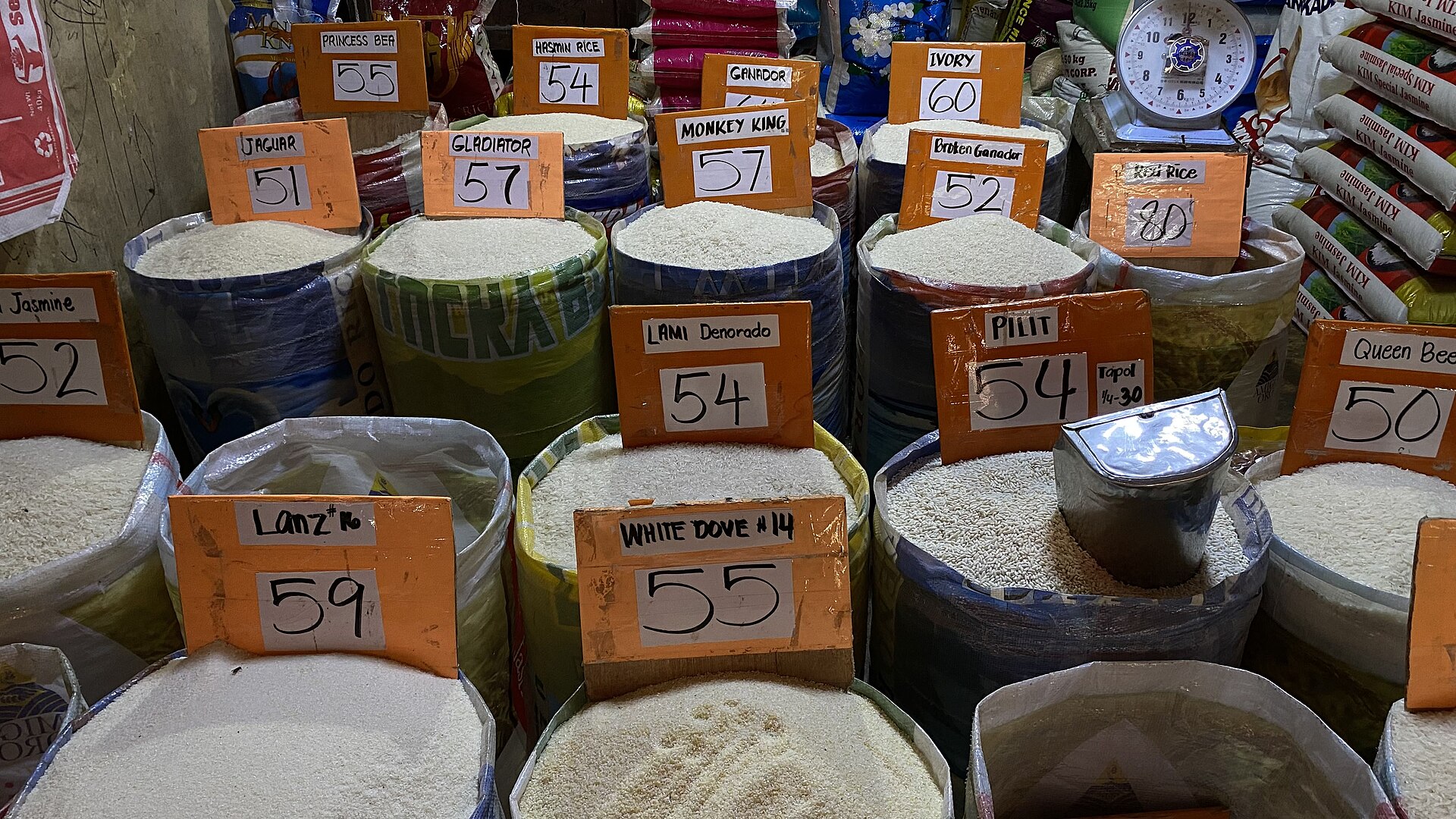
- Compare types of rice, not just shops. At the Cebu stall in the photo below, taken in June 2026, white rice was priced from ₱50 to ₱60 a kilo. Switching to a cheaper type shows up quickly in your food total.
Writing down every purchase for a few weeks takes effort. But it turns 7.2% into a number about your own home. One way to do it is Cashmonki's spending charts, which split your spending by category and compare one month with the next.
Sources
- Philippine Statistics Authority, Summary Inflation Report, Consumer Price Index (2018=100): September 2026, released 6 October 2026
- Bangko Sentral ng Pilipinas, Highlights of the Monetary Board meeting, 27 August 2026
- Bangko Sentral ng Pilipinas, Highlights of the Monetary Board meeting, 18 June 2026
- Bangko Sentral ng Pilipinas, Highlights of the Monetary Board meeting, 23 April 2026
- Bangko Sentral ng Pilipinas, 2026 calendar of monetary policy meetings
- National Wages and Productivity Commission (DOLE), NCR current daily minimum wage rates
- International Monetary Fund, World Economic Outlook, inflation, average consumer prices: Philippines
- Asian Development Bank, Philippines: economy, Asian Development Outlook September 2026
- BusinessWorld, Poll: BSP to hike rates by 25 bps anew, 18 October 2026
- BusinessWorld, Peso ends flat as market awaits BSP policy move, 20 October 2026
- BusinessWorld, Philippines to see sluggish growth, rise in unemployment this year, says IMF, 13 October 2026
- BusinessWorld, Philippine inflation heats up to 3-year high in April, 6 May 2026
- BusinessWorld, Philippines core inflation hits 31-month high as headline CPI eases in June, 8 July 2026
- GMA News, Inflation snaps four-month easing, accelerates to 7.2% in September 2026, 6 October 2026
- GMA News, Inflation cools down to 6.8% in May 2026, 5 June 2026
- SunStar, PH inflation jumps to 7.2% in September, 6 October 2026
- Daily Tribune, Transport cools June inflation to 6.4%, 7 July 2026
- Daily Tribune, Inflation eases to 6.2% in July, 5 August 2026
- Daily Tribune, Inflation eases to 6.1% as rice prices surge, 4 September 2026
Common questions
Prices were 7.2% higher in September 2026 than in September 2025, according to the Philippine Statistics Authority (PSA). In August the rate was 6.1%. From January to September 2026, it averaged 5.4%.
Rice cost 20.3% more in September 2026 than a year earlier, based on the PSA's rice price index. In August the rise was 19.4%. This is a national average, so prices where you live may have gone up more or less.
The policy rate is the central bank's main interest rate, and it affects what banks charge for loans. The Bangko Sentral ng Pilipinas (BSP) calls it the target reverse repurchase rate. It is now 5.00%, after a rise of 0.25 percentage points on 27 August 2026. That was the third rise in a row. The BSP's next rate meeting is on 22 October 2026.
Yes. Wage Order No. NCR-28 raised the daily minimum wage for non-farm workers by ₱60, from ₱695 to ₱755. It took effect on 26 September 2026, according to the National Wages and Productivity Commission.
See your own inflation: log a month of food and fuel spending in Cashmonki, then compare it with the next.
Free to start · No account needed · No ads
On a computer? Scan with your iPhone camera.